What is Feng Shui? A Beginner’s Guide to Space Harmony
What is Feng Shui? Understanding the Ancient Art of Space Harmony
Feng Shui (pronounced “fung shway”) is an ancient Chinese practice that studies how the arrangement of your environment affects your energy, mood, and fortune. The term literally translates to “wind-water” — two forces that flow through everything in nature. At its core, Feng Shui teaches that the layout of your home, office, or any space can either support or disrupt the natural flow of qi (life energy), influencing your health, relationships, and success.
With roots stretching back over 3,000 years, Feng Shui combines philosophy, astronomy, and geomancy to create spaces that feel balanced and harmonious. Whether you’re arranging furniture, choosing colors, or buying a house, Feng Shui offers a framework for making decisions that align with cosmic energy patterns.

Photo by Alex Shute on Unsplash
The Five Elements Theory
One of the foundational concepts in Feng Shui is the Five Elements (Wu Xing): Wood, Fire, Earth, Metal, and Water. Each element corresponds to specific shapes, colors, materials, and life aspects. Balance comes from having all five elements present in harmonious proportions.
| Element | Colors | Shapes | Life Area |
|---|---|---|---|
| Wood | Green, Brown | Rectangular, Tall | Growth, Family |
| Fire | Red, Orange, Purple | Triangular, Pointed | Passion, Recognition |
| Earth | Yellow, Beige, Terracotta | Square, Flat | Stability, Health |
| Metal | White, Gray, Silver | Round, Circular | Focus, Abundance |
| Water | Blue, Black | Wavy, Curved | Wisdom, Career |
The Bagua Map: Your Space Blueprint
The Bagua (or Ba Gua) is an octagonal map used in Feng Shui to overlay onto your floor plan. Each of the eight areas corresponds to a different life aspect — from wealth and career to love and family. By identifying which Bagua area your bed, desk, or front door falls into, you can activate that part of your life with specific colors, elements, or objects.
For example, if your front door opens into the “Wealth” corner (southeast), adding a small water feature or purple accents near the entrance can help attract prosperity. The Bagua turns your home into a living map of your life’s potential.
Yin and Yang in Your Space
Feng Shui also balances Yin (passive, soft, dark) and Yang (active, bright, stimulating) energies. A bedroom should lean Yin — calm and restful — with soft lighting and muted colors. A home office needs more Yang — good lighting, energetic colors, and an active layout. Too much of either creates imbalance: an overly Yang bedroom disrupts sleep, while an overly Yin office kills productivity.
Simple Feng Shui Tips to Try Today
- Declutter your entryway — the front door is where qi enters. Keep it clean and inviting.
- Fix what’s broken — a chipped mug or stuck drawer represents stagnant energy. Repair or replace.
- Use the commanding position — place your bed and desk so you can see the door without being directly in line with it.
- Bring in plants — living greenery activates Wood energy and purifies the air.
- Reduce clutter under your bed — items stored beneath you can disturb sleep energy.
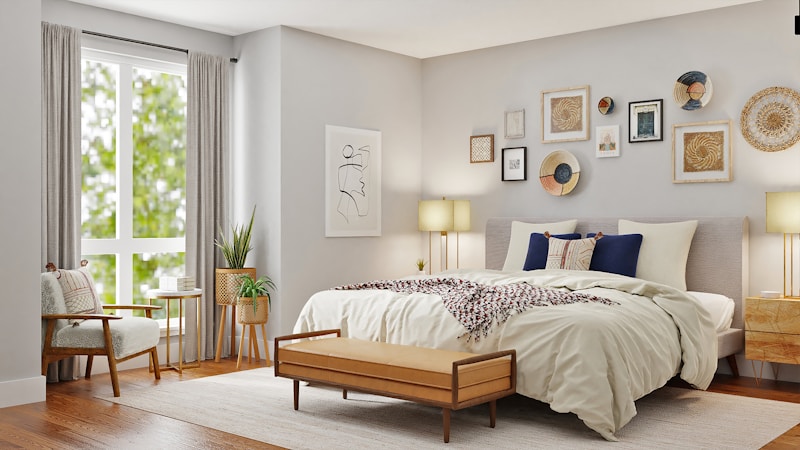
Photo by Spacejoy on Unsplash
Common Misconceptions
Many people think Feng Shui is superstition or interior decoration in disguise. In reality, it’s a sophisticated observational science that evolved from ancient Chinese understanding of topography, astronomy, and energy patterns. Modern environmental psychology confirms many Feng Shui principles — room layout affects mood, natural light boosts well-being, and clutter creates mental stress.
Feng Shui doesn’t require buying expensive “cures” or rearranging your entire home overnight. Start with one room, one corner, and notice how it feels. The practice is ultimately about developing awareness of how space shapes your experience — and using that awareness to create environments where you can thrive.
Want to go deeper? Explore how Feng Shui interacts with your personal birth chart in a Face & Space Reading session.