Mirror Facing Your Bed: What Chinese Feng Shui Actually Says, and Five Fixes That Do Not Require Moving Furniture
Most people who ask about a mirror facing the bed are not asking about ghosts. They are asking a narrower, more practical question: will this thing in my bedroom keep me awake? The mirror is usually inherited, built into a closet door, or stuck to the only wall with room for it, and the advice online splits into two camps that never address each other. One says a mirror near the bed is an open door for bad luck; the other says it is a piece of glass and nothing more.
Chinese feng shui sits between those two positions, and the traditional reasoning is more specific than either camp admits. The practice itself is old — feng shui (literally “wind-water”) is conventionally dated to the Zhou dynasty, roughly three thousand years ago. But the rule that concerns you is not “never own a mirror.” It is a rule about what a mirror reflects while you are asleep, and once that is clear, the fix is usually a repositioning rather than a renovation.
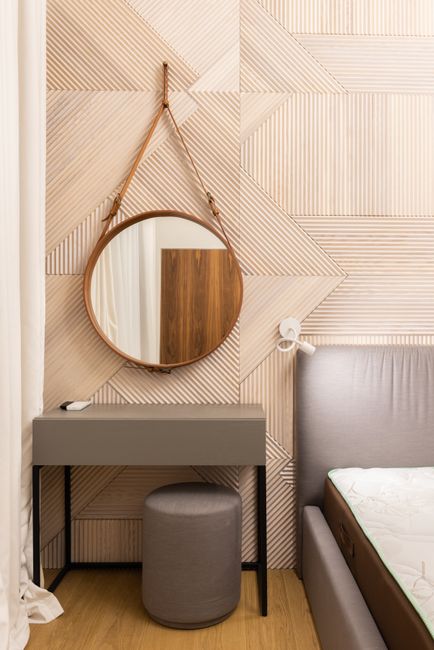
Why a mirror at the foot of the bed unsettles sleep in Chinese feng shui
In the classical reading, a mirror at the foot of the bed creates a second bed. The reflection doubles the room, and the sleeping body appears alongside itself — an arrangement the tradition calls restless, because the part of you that rests is understood to be mirrored and multiplied rather than settled. This is the source of the older and more colourful claim that a mirror near the bed invites a third presence into the room. The image is memorable, but the practical concern underneath it is simple: the mirror turns a still, closed space into an open one, and sleep depends on the space feeling closed.
The second strand is directional. A mirror facing the bed usually faces the bedroom door as well, or reflects the doorway behind you. Chinese feng shui treats the bed as the one place where you should not be watching the entrance. You want to see the door from the bed so that you are not startled by it; you do not want to lie with your back to it, and you do not want its reflection hovering over your sleeping body. That is why a mirror at the foot of the bed and a mirror on the wall directly opposite the door are treated as the same problem.
What the traditional reasoning rests on, and what it is not
It is worth separating the parts of this rule you can verify from the parts you simply choose to follow. Lying in bed at night, a large reflective surface catches every passing light — a phone screen, a car outside, a hallway lamp. Bright light in the evening suppresses melatonin, the hormone that signals the body to wind down, and the mild alert that follows is exactly the wrong state for falling asleep. A mirror angled toward the bed multiplies the effect, because the room appears to contain more movement than it does.
This is not a superstition about glass. It is a description of how a small bedroom behaves at night, and it explains why the traditional remedy is so often a cover rather than a removal. The sleep problem it addresses is common: the US Centers for Disease Control and Prevention has reported that roughly one in three adults does not get enough sleep on a regular basis (CDC, 2022). The tradition is also not fatalistic. Nothing in the classical texts says that a badly placed mirror cancels good fortune permanently; the language is about disturbance and rest, both of which are adjustable. Treat a mirror problem as a sleep-hygiene problem with a household remedy, not as a verdict on your year.
The mirror rule only makes sense inside the command position
Feng shui advice reads contradictory online because people quote single rules without the framework that orders them. That framework is the command position, and it decides everything else in the bedroom. Read it once, and the mirror rule stops looking like an isolated superstition and becomes the third of three related points.
- The headboard sits against a solid wall. Not a window, not a half-wall shared with a corridor. A solid wall behind you is the base of the reading, which is why a bed pushed under a window is treated as exposed even when the view is lovely.
- You can see the door from the bed without lying directly in line with it. Diagonal sightline, no doorway at your feet. This is the “coffin position” that experienced practitioners warn people away from, and it is why a bed placed for convenience rather than sightline tends to feel wrong even when it looks tidy.
- Nothing reflective or sharp is aimed at the sleeping body. Mirrors, glossy wardrobe doors, and dark screens all fall under this. The mirror is not a special category of object; it is simply the most common offender.
Once you read the bedroom this way, the contradictions dissolve. Two people can give you opposite-sounding advice about the same bookshelf — one telling you to build a barrier so you cannot see the door, the other calling that a mistake — and both may be describing the same underlying principle. Seeing the door is good. Blocking it so completely that you cannot see it at all is not, because the aim is a clear diagonal sightline rather than a wall of furniture.
Five fixes for a mirror that cannot leave the bedroom
Renters and small apartments rarely get to choose where the mirror goes, and the traditional answer — move it — is often unavailable. These five options preserve the sleep benefit without a renovation, ordered from least to most disruptive.
| Fix | What it does | Works when | Cost |
|---|---|---|---|
| Cover the mirror at night | Removes the reflection during the hours that matter | The mirror is fixed to a wardrobe door or wall | A cloth or a slim curtain track |
| Angle the mirror away from the bed | Breaks the direct line between glass and sleeping body | The mirror sits on a stand or a hinged arm | Free |
| Move the mirror to a side wall | Keeps it useful for dressing without facing bed or door | There is 40 to 60 cm of wall on either side of the bed | Free |
| Swap it for artwork or a textile | Removes the reflective surface entirely | The mirror was decorative rather than functional | Cost of a framed print |
| Switch to a closed storage mirror | Keeps a mirror available but stores it out of sight | You are willing to buy a wardrobe or cabinet mirror | Furniture cost |
The cover is the oldest fix and the one most people actually keep. A lightweight curtain on a slim track above a built-in mirror takes ten minutes to install and removes the whole problem at night while leaving the mirror usable in daylight. If the mirror is the only surface making the room feel larger, this is the compromise to make: the room stays bright, and the reflection is not there while you sleep.
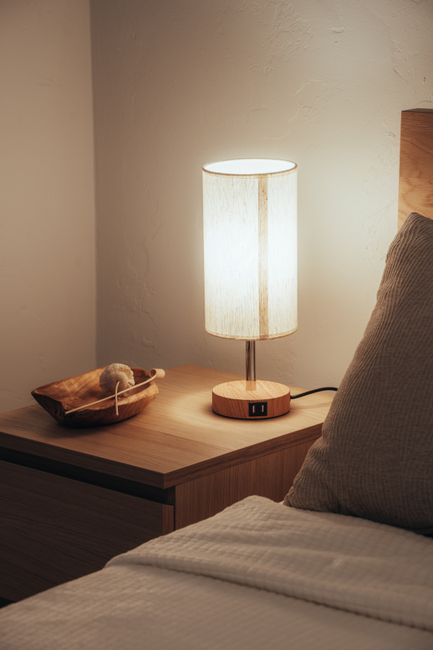
How to tell whether the problem is the mirror, the bed position, or the room itself
Changing furniture and finding that nothing improves is the most common frustration in bedroom feng shui, and it usually means the diagnosis was wrong. Three quick tests separate the possibilities, and each one points to a different fix.
- If you wake in the night and your eye lands on the mirror first, the mirror is the issue. Cover it or angle it.
- If you sleep badly in this room but fine in a hotel or at a relative’s house, the bed position is the likelier cause. Check the headboard wall and the door sightline before touching anything else.
- If the room feels heavy in daylight too — low light, dark walls on every side, furniture crowding the walking path — the problem is the room, and no mirror adjustment will fix it. In long discussions about resetting a flat after a separation, the most useful replies were about paint and light rather than furniture: a dark green room that reads as cosy in photographs can read as a cave in February.
When to set feng shui aside and check something physical first
The tradition is a framework for arranging a room, not a substitute for looking at the room. If you moved into a new bedroom and started getting migraines or waking up congested, the first thing to rule out is not the mirror. It is damp, mould, dust, and ventilation — a leak behind a wardrobe, a bathroom without an extractor fan, an ageing mattress, a heating vent blowing across the bed. Experienced practitioners say this as readily as anyone; a reading that ignores a visible water stain is not being spiritual, it is being unhelpful.
The bedroom advice that survives every school of feng shui is therefore unglamorous: sleep where you can see the door, put a solid wall behind you, keep reflective and moving surfaces out of the line of your body, and fix the physical problems first. Everything else is decoration.
Frequently asked questions about mirrors and beds in feng shui
Does the mirror have to be removed from the room entirely? No. The traditional concern is the relationship between the mirror and the bed while you sleep, not the presence of glass in the room. A mirror on a side wall reflecting a wardrobe is not treated as a problem, and a covered mirror is not treated as a problem at all.
What if the mirror is built into a wardrobe door opposite the bed? Cover it. A curtain on a slim track is the standard remedy and keeps the mirror usable during the day. If the wardrobe is new and the layout is still open, put the mirrored panel on a side rather than the front.
Is a mirror beside the bed as bad as one at the foot of the bed? Beside is milder. The problem scales with what the glass reflects and how much of the sleeping body it doubles, so a small side mirror catching a corner of the bed is a different case from a full-length mirror aimed at the mattress.
Does the same reasoning apply to a television or a monitor? It does, and for the same reason: a dark screen is a reflective surface facing the bed. If it cannot be moved, cover it or angle it. The practical effect on sleep is the same as with a mirror.
Can the bed simply be turned instead? Often yes, and this is the cleanest fix when there is room. Rotating the bed so the mirror reflects a wall rather than the bed solves the reflection and the door-sightline problem in one move, provided the new headboard wall is solid.
What to do this week
Pick one change and give it two weeks. Cover the mirror, or rotate the bed so the mirror no longer faces it, and leave everything else alone. If sleep improves, the diagnosis was right; if it does not, you have ruled out the mirror cheaply and can examine the bed position next.
If the line above the bed is what bothers you rather than the glass beside it, the companion reading on a beam running over the bed covers that case with the same framework.
For the wider framework behind these decisions, the guide to reading the bagua map in real rooms shows how the eight areas are applied in practice, and the compass-based lucky direction method pairs naturally with the command position. If your interest leans more toward the timing of decisions than the arrangement of rooms, the lunar calendar work on LunarRead is a natural next step.
Want a reading for your own situation?
The free Destiny Report takes a minute: leave your email address and pick a number between 1 and 99, and you get a short reading built from the same Chinese systems used on this page. No payment, no subscription.