Palm Lines Explained: What the Life, Head, Heart, Marriage and Fate Lines Describe
Palmistry is one of the oldest systems for reading a person, and it is also one of the most misunderstood: most of what circulates online treats each line as a fixed verdict rather than as a pattern of tendencies. The Chinese, Indian and Greek traditions that shaped modern palm reading all treat the hand as a map of habits, resilience and change over time — not a countdown clock.
This guide walks through the five lines that carry most of the reading — life, head, heart, marriage and fate — then explains how small markings (islands, chains, breaks, forks) modify what a line is saying. Every point below is the traditional reading; where a line has been commonly exaggerated, the guide says so plainly.
The life line describes vitality, not lifespan
The life line is the arc that starts between the thumb and the index finger and curves down around the base of the thumb. Its Chinese name translates closer to vitality line than to life line, and that is the reading it carries: energy, resistance to illness, and how a person recovers from strain. A long line is not a long life.
A long, deep, well-coloured line is read as strong vitality and good recovery. A shallow or broken-looking line is not a death sentence — it is traditionally read as lower reserves, which is why the same texts advise rest, food and routine rather than worry.

The size of the mount it encloses — the fleshy pad at the base of the thumb — is read as appetite for life. A wide, full mount suggests stamina and physical drive; a narrow one suggests lower reserves and a need for pacing.

A chain pattern at the start of the line — small links rather than one clean stroke — is traditionally linked to a delicate early childhood: frequent illness, sensitivity, or a slow start in health.

A fringed or tasselled ending — the line fraying into many small strands — is read as the wear of later years: the body asking for gentler pacing rather than sudden strain.

An island on the line — a small enclosed loop — marks a period rather than a lifetime: a stretch of illness, surgery or forced rest. The larger the island, the longer the stretch it is read as covering.

A short head line is about focus, not intelligence
The head line (also called the brain line, and in Chinese practice the human line) runs from the same starting point as the life line across the middle of the palm toward the ring-finger side. It is read as thinking style: how a person concentrates, decides, and handles detail.
A deep, fine head line is read as clear concentration and good memory. An island on the head line is traditionally associated with scattered focus, forgetfulness, or a period of mental strain rather than a permanent trait.

Where the head line separates from the life line matters more than its length. Joined at the start for a stretch, then separating, reads as cautious and deliberate — thoughtful, but slow to decide. Separate from the very beginning reads as bold and independent; a very wide gap is read as impatience, acting before thinking.

The heart line shows how someone relates to love
The heart line begins under the little finger and travels toward the index finger. Its endpoint is the part practitioners read first, because it describes the style of attachment rather than the amount of feeling: resting between index and middle finger reads as balanced, ending under the index finger reads as idealistic and emotionally led, and running under the middle finger reads as physical and present-focused.
Curling downward under the middle finger is read as intensity that can tip into stubbornness — wanting the relationship on set terms.

A long heart line that forks and dips is the traditional picture of someone willing to give up a great deal for a relationship — devotion that needs boundaries to stay healthy.

Depth of the line is read as depth of feeling: a fine, clearly etched line suggests sensitivity to emotional detail, while a broad, shallow line suggests a more matter-of-fact emotional style.
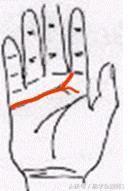
Feathery lines branching upward from the heart line are read as warmth and responsiveness; branching only on the upper side is traditionally called the wit line, suggesting quick, adaptable reactions. When the heart line itself is a chain of small links, the reading is emotional sensitivity — feeling things deeply and for longer than others might.

An island under the ring finger is traditionally read as strain on the eyes — short sight, astigmatism, or long hours of close work. The same island further along the line is read as emotional turbulence rather than anything physical, which is a good example of how palmistry reuses one shape for different meanings in different locations.

A clear break in the heart line is the marking most often quoted out of context. It is read as a significant emotional rupture — a relationship ending, a betrayal, a period of grief — and the line typically resumes, which is precisely the point: the tradition describes an interruption, not a permanent condition.


What the marriage line actually records
The marriage lines sit on the edge of the palm below the little finger, between the heart line and the base of the finger. Most hands carry several, and the number is not a count of marriages — the traditional reading concerns the quality and structure of close relationships, and practitioners normally read only the deepest line as the significant one.
Two lines of equal depth are read as being pulled between two people or two commitments at once; more than six faint lines with no clear main line is read as a life where relationships are numerous but loosely defined.

A long marriage line is read as high standards — choosing carefully and expecting a lot from a partner, which creates both satisfaction and pressure. Where that line reaches the sun line (the vertical line under the ring finger), the tradition reads partnership as a source of standing and support; crossing the sun line instead is read as the relationship costing something in reputation or money.

A forked ending is read as separation — two paths heading in different directions — and this is the marking most often misquoted as a prediction of divorce. Read it as a relationship pattern that needs conscious maintenance rather than a scheduled event.

An island on a marriage line is read as a period apart: living in different places, a long separation for work, or a stretch of emotional distance rather than a permanent split.

A marriage line that tips upward at the end was traditionally read as reluctance to formalise a relationship — a preference for the partnership as it is, without the paperwork.

The fate line tracks a working life
The fate line (also called the destiny line) climbs from the base of the palm toward the middle finger. Where the other lines describe temperament, this one is read as the shape of a working life: how stable the path is, and what tends to redirect it.
A single unbroken line is read as a consistent direction, one career built steadily. A series of disconnected segments is read as a working life of changes — different employers, different fields, or repeated restarts — which in a modern economy describes most people rather than a warning.
Where the fate line stops is read as what interrupts the path: stopping at the head line suggests a change of direction decided by the person themselves, while stopping at the heart line suggests a change driven by a relationship. Two fate lines running in parallel is the classic reading for a second income or a side business developed alongside the main career — the most useful reading in this section for anyone balancing a job with a project.

How islands, chains, breaks and forks change a reading
Almost every subtlety in palmistry comes from four shapes, and they mean the same thing wherever they appear. This is the part of the system worth learning, because it stops a marking from being read as a verdict.
| Marking | What it looks like | Traditional reading |
|---|---|---|
| Island | A small enclosed loop inside a line | A period of strain or interruption, not a permanent state — the size suggests how long it lasts |
| Chain | Small links instead of one clean stroke | Sensitivity or instability in that part of life; at the start of the life line it points to early childhood |
| Break | A clear gap where the line stops and resumes | A rupture or change of direction; the line continuing afterwards is read as recovery |
| Fork | The line splitting into two ends | Two directions at once — a choice, a split, or a divided emphasis in that area of life |
What people ask about palm reading
Is palm reading accurate? It is a traditional pattern-reading system rather than a measurement. The useful way to hold it is as a mirror for habits and tendencies — many people recognise themselves in a reading, which says something about how humans interpret broad descriptions as much as it says about hands.
Can palm lines change over time? Yes. Major creases deepen, and finer lines appear and fade as hands are used. That is the strongest argument against reading any line as a fixed verdict, and the classical texts treat lines as records of what a person has been doing with their life.
Does a short life line mean a short life? No. The line is read as vitality and recovery, and the name is a mistranslation of the older term. A short, deep line and a long, faint one are read differently in quality, not in years.
Which hand should be read? The common convention is that the dominant hand describes the active, current life and the other hand describes the foundation someone starts from. Reading only one hand gives half the picture; comparing the two is where the interesting differences show up.
Do marriage lines predict divorce? No. A forked or broken marriage line is read as a relationship pattern that needs attention — communication, distance, competing commitments — rather than a scheduled event.
Which line matters most? Traditions differ, but most working practitioners start with the head line, because it describes how a person thinks and decides, which shapes everything else the hand shows.
How to read a palm without treating it as a forecast
The lines are worth reading as a self-assessment tool: a way to name a pattern that is already visible in behaviour, and then decide whether to keep it. The tradition itself is explicit that a marking describes a tendency, and that hands change as people do. Treat the reading as a conversation starter, not a timetable.
If you want the same approach applied to a specific question — a relationship, a move, a career decision — the free report on this site takes your email and a number between 1 and 99 and returns a short reading. For the wider framework, the beginner’s guide to reading palm lines covers the hands themselves, and the palm reading 101 walkthrough goes line by line. Face reading follows the same logic on a different surface, explained in the basic face reading guide, and if you prefer to start from the birth chart rather than the hand, calculating your zodiac element is the natural entry point. For background on the tradition itself, Encyclopaedia Britannica’s entry on palmistry and the historical overview on Wikipedia both cover its origins. Readers who plan around dates rather than lines can follow that thread at LunarRead.
Want a reading for your own situation?
The free Destiny Report takes a minute: leave your email address and pick a number between 1 and 99, and you get a short reading built from the same Chinese systems used on this page. No payment, no subscription.