Why a Beam Above the Bed Feels Heavy: The Chinese Feng Shui Reading, and Five Fixes for Renters
Almost every bedroom feng shui question that begins with a photo of a ceiling ends the same way: there is a beam, it runs directly over the mattress, and no furniture can be moved because the room has exactly one usable wall. The traditional name for the problem is simple — the beam presses the bed — and the traditional answer is equally simple, which is the difficulty: move the bed. When you cannot move the bed, the advice usually collapses into vague reassurance or into buying an object.
Chinese feng shui treats a beam as one of the few structural features that genuinely matters, and the reasoning behind it is narrower and more sensible than the doom-laden version circulating online. A beam over a bed is read as weight and division placed over a resting body: a line of pressure where there should be none, splitting the space you sleep in. Once you see it that way, the fixes become a matter of geometry and light rather than luck — and most of them are affordable in a rented flat. The hardest version of the question arrives in small studios, where beams cross both usable walls and the bed, the sofa, and the desk all end up underneath something.
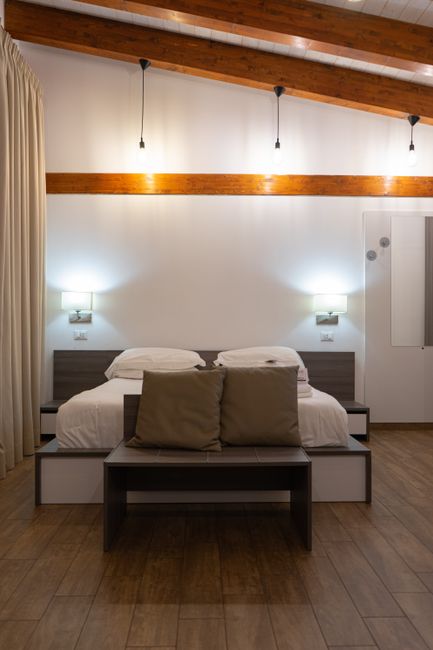
What “the beam presses the bed” actually describes in Chinese feng shui
In the classical reading, a beam is a line of concentrated structure. Everything above it carries load, and the beam is the visible evidence of that load. Placing a bed underneath means sleeping beneath a compressed line, and the tradition describes the result in the language of pressure: restlessness, a mind that will not switch off, tension that settles in the shoulders and neck, and a sense that the room is working against you rather than holding you. The older metaphor is dramatic — some texts speak of a blade over the body — but the operative idea is that pressure belongs over a desk or a doorway, never over the place where a body lies still for eight hours.
Two details of the traditional rule are widely misunderstood. The first is that position matters more than presence. A beam over the foot of the bed, across the middle of the mattress, and above the pillow are treated as three different cases, and the version to take seriously is the one crossing the torso or the head. A beam over a walkway or over a wardrobe is not the same problem, because nobody sleeps there. The second is that the tradition does not treat the beam itself as cursed. It treats it as a fixed feature that creates an awkward sleeping position, and the standard remedy across the classical texts is a change of place, not the destruction of the structure.

The part of the beam problem that is not superstition at all
Sleeping under a beam is one of the rare feng shui concerns with an obvious physical component, and separating the two makes the fix easier to choose. A beam creates visual weight overhead, and people are reliably sensitive to overhead enclosure. In a 2015 study published in the Journal of Environmental Psychology, participants rated rooms with higher ceilings as more beautiful and were less willing to enter a version of the same room when it felt more enclosed (Vartanian et al., 2015). A beam sitting 30 to 60 cm below a ceiling lowers the perceived ceiling exactly where your eyes rest when you lie down and look up.
The second physical component is maintenance. Exposed timber collects dust in a way that a flat painted ceiling does not, and a bedroom where dust settles overhead is a bedroom where someone with a pollen or dust-mite sensitivity sleeps worse. Open-beam ceilings in older buildings also conceal the wiring, plumbing, and heating runs of the floor above, which is why a beam over the bed sometimes arrives with creaking, knocking pipes, or a warm patch in the plaster. And where a beam carries a fan or a light, the fixture usually sits directly over the mattress — the one place in the room where moving air and hard light are least welcome.
None of this means the tradition is secretly engineering. It means the beam case has two honest layers: an arrangement layer that responds to repositioning and softening, and a comfort layer that responds to a vacuum attachment, a lamp with a warm shade, and turning a fan away from the bed. A sleeping environment that feels calm is not merely decorative. The US Centers for Disease Control and Prevention has reported that roughly one in three adults does not get enough sleep on a regular basis (CDC, 2022), and a beam is not the cause of that — it is simply a bad place to spend the hours you do get.
One beam is not the same as another: reading the four common cases
Before rearranging anything, identify which case you are dealing with, because the effort required differs by an order of magnitude.
| Case | What it looks like | How serious in feng shui terms | Cheapest response |
|---|---|---|---|
| Beam crossing the torso or head | A single beam or a pair running across the mattress | The classic case; read as pressure on the resting body | Shift the bed 60 to 90 cm so the beam crosses a walkway instead |
| Beam above the foot of the bed | The line crosses near the ankles | Milder, but still a line over the sleeping area | Rotate the bed 180 degrees if the wall allows it |
| Beam against the headboard wall only | The beam meets the wall above the pillow | Usually acceptable if the headboard is solid beneath it | Nothing, or a headboard that stops short of the beam |
| Sloped or attic ceiling | A whole plane descending toward the bed | Read as the room closing in on the sleeper | Move the bed to the highest point of the slope |
That table explains a contradiction you will meet in forums: two people describe the same room, and one is told the beam is fine while the other is told to move everything. They are almost certainly describing beams in different positions relative to the mattress.
Five fixes that work when the bed cannot move
The traditional remedy is relocation, and it remains the best one when the room allows it. The rest of the list is what to do when the lease, the radiators, or the door make relocation impossible. Fixes one and two are free, fixes three and four cost a weekend, and the fifth is the one to choose only when the beam is genuinely immovable.
| Fix | What it changes | Works when | Typical cost |
|---|---|---|---|
| Shift or rotate the bed | Removes the beam from over the sleeping body | There is 60 cm of slack on any side of the room | Free |
| Move the pillow line only | Puts the beam over the foot of the bed or the walkway | The mattress can slide along the same wall | Free |
| Soften the beam visually | Paints it to match the ceiling and removes its shadow line | You can paint, or the beam is already light-coloured | A tin of ceiling paint |
| Hang a canopy or a fabric panel | Interrupts the line overhead and covers it while you sleep | Rental, and you want it reversible in one hour | Tension rods and two curtains |
| Box in the beam or add a suspended ceiling | Physically removes the visible structure | You own the flat and the ceiling height allows it | Trade work |
The cheapest of these is also the most effective: a bed shifted so the beam runs over a walkway, a wardrobe, or a doorway instead of the mattress solves the arrangement problem completely, and it costs nothing. Traditional practice adds one refinement worth knowing — when a beam cannot leave the sleeping area entirely, the aim is for it to cross below the feet or beyond the pillow rather than over the chest, on the logic that the part of the body you rest is the part that should not be shadowed.
Fabric is the renter’s answer, and it works for a reason that is easy to underestimate. A beam is read as pressure partly because of the hard shadow line it casts on the ceiling. Cover the line and you remove both the shape and the shadow. The common solution is not a four-poster bed: a tension rod with two long curtains hung just below the beam, or a light canopy that runs parallel to it, is enough to break the line and it comes down in ten minutes when you move out.

What to do when the line overhead is a duct, an attic slope, or a listed beam
Not every heavy line overhead is a beam, and identifying what you are actually looking at changes the advice. A boxed-in duct, a soffit built to hide pipework, and a structural timber look similar in a photograph taken from bed height, but they behave differently in the room.
- A duct or soffit is usually noisier than a beam and sometimes warmer to the touch. If the line above your bed carries air or water for another flat, the practical problem is the sound and the temperature swing, and the traditional answer — sleep where the line does not cross you — matches the practical one exactly.
- An attic or sloped ceiling is read as enclosure rather than pressure. The traditional fix is to place the bed under the highest point of the slope, which is also where the room feels least like a bunk and where warm air has somewhere to go.
- Listed or heritage beams cannot be boxed in or painted without permission. Covering with fabric becomes the main option, and it is a good one: it is reversible, it requires no fixing into old timber, and it removes the shadow line that makes the beam read as weight from the pillow.
- Two beams forming a grid over the bed is treated as the strongest version of the problem, simply because more of the sleeping area sits under structure. Moving the bed out of the grid, even by a metre, is worth more than any object hung afterwards.
Practitioners also tend to raise one question that people rarely ask themselves: is the line above the bed really where the trouble is, or is the bed simply in the only place the door and the window allow? If the room forces the position, the honest answer is that fabric, paint, and a repositioned lamp will get you most of the way, and the rest is out of your hands until you move.
What people ask before they move a bed
Does a beam matter if it is not directly over the mattress? No. The traditional concern is the relationship between the structure and the sleeping body. A beam over a wardrobe, a walkway, or a doorway is not treated as a problem, and a beam that stops at the headboard wall is often considered acceptable.
Can I hang coins, a gourd, or a mirror to solve it instead? These are traditional remedies, but they are the secondary layer, not the fix. A protective object does not change where the beam crosses your chest, and the classical instruction for this specific problem is still to relocate. If a charm helps you stop thinking about the ceiling, keep it; just do not let it replace the move that actually changes the geometry.
What if the beam crosses the room the other way, over my feet? That is the milder case, and many practitioners leave it alone. If it bothers you, rotating the bed so the beam sits behind the pillow rather than over the mattress is usually enough.
Is a ceiling fan on the beam the real issue? Often, yes. Air moving across your face all night and a light source at the exact centre of your field of view do more measurable damage to sleep than a timber line does. Turn the fan away or off at night, and replace any bare bulb above the mattress with a shaded, warm lamp that is not visible from the pillow.
Does the same rule apply to a bunk bed or a shelf fixed over the bed? It applies to any structure placed over a sleeping body, and a heavy shelf is treated slightly more seriously than a beam because it can also fall. Move the shelf; keep the bunk only if the lower sleeper is not directly beneath a hard edge.
How to test a single beam fix for two weeks
Pick a single change and give it a fortnight, because changing three things at once tells you nothing. If the bed can move, move it so the beam crosses the walkway and leave the rest of the room as it is. If it cannot, hang fabric under the beam, put the lamp on the far side of the bed, and stop the fan blowing across your pillow. Note how you sleep for two weeks. If nothing shifts, you have eliminated the beam cheaply and you can look at the bed position and the room’s air next — the sequence the tradition has always used, from the fixed structure inward.
Two other pages on this site carry the rest of the framework. The walkthrough of the bagua map, area by area, covers what each zone of a room is understood to govern, while working out your Kua number adds the compass layer that decides which direction a headboard should face. If a mirror shares the wall with your beam, the earlier reading on mirrors and beds applies the same logic to reflective surfaces. Readers who plan around dates rather than layouts can follow that thread at LunarRead.
Want a reading for your own situation?
The free Destiny Report takes a minute: leave your email address and pick a number between 1 and 99, and you get a short reading built from the same Chinese systems used on this page. No payment, no subscription.